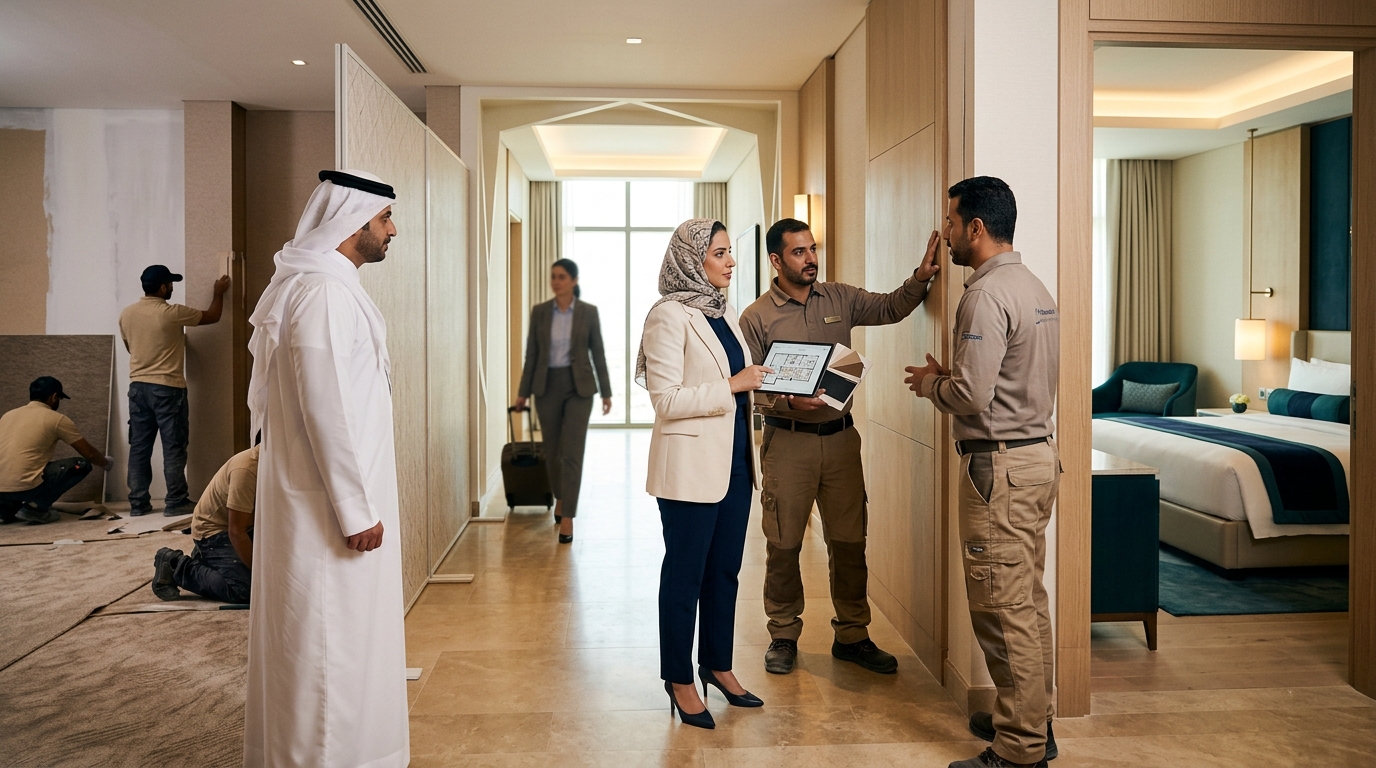
Owners in Qatar refurbish hotels to keep their star rating, their operator and their rate. Here is how to phase a guest-room renovation while the hotel trades, what it costs per key and how to choose the team.
Qatar's hotel stock grew fast around 2022, and a large share of it is now reaching the seven-to-ten-year point where soft goods are tired, bathrooms date the room and the operator's brand standards demand a refresh. Closing the hotel is rarely an option; the debt does not pause and the staff do not disappear. The answer is a phased guest-room renovation, floor by floor, that keeps the hotel trading at 75 to 85 per cent of capacity while the work moves through the building.
Three levels of refurbishment and what they cost
Per key, for a four-star hotel in Doha in 2026, including bathroom and corridor allowances but excluding public areas:
- Soft refurbishment (carpet or flooring, paint, wallcovering, curtains, bedding, lighting, minor joinery repair, bathroom regrout and fittings): QAR 45,000 to 80,000 per key, 5 to 7 days per room in the cycle.
- Mid refurbishment (all of the above plus new headboard wall, wardrobe and desk joinery, new bathroom vanity, tiles and sanitaryware, new FF&E, TV and controls): QAR 90,000 to 160,000 per key, 3 to 4 weeks per floor.
- Full renovation (strip to shell, new layout, bathrooms rebuilt, MEP upgrades, full FF&E and technology): QAR 180,000 to 320,000 per key, 6 to 10 weeks per floor.
A 150-key hotel on the mid level is a QAR 15 to 25 million programme, running 9 to 14 months. Public areas, kitchens and MEP plant are separate decisions and usually phased around the room programme.
The floor cycle
1. Decant: the operator blocks the floor; front office moves guests. Two floors out at a time is the usual compromise between speed and revenue.
2. Strip-out and protection: waste routed through a dedicated lift or external hoist, corridors sealed with dust screens, working hours agreed (typically 9 am to 5 pm, no percussive work at guest-sensitive times).
3. First fix and wet works: bathrooms, MEP changes, waterproofing tests before tiling. This is where phasing programmes slip.
4. Finishes and joinery, then FF&E installation from a staged stock, then deep clean, snagging with the operator's housekeeping and engineering, and handover.
5. Move to the next floor with the same crew, which is why the first floor takes longest and the fifth is fast.
Guest and operator management
The operator's cooperation decides the programme. Agree in writing: which floors when, noise windows, lift allocation, the route for materials and waste, fire-system isolations with Civil Defence-compliant procedures, and a daily coordination meeting. Communicate the renovation to guests as a positive (new rooms, a discount during works) rather than hiding it; reviews punish surprise noise, not announced work.
Procurement: FF&E first
The single most common cause of delay is furniture arriving after the floor is ready. Approve the model room (one full room built and signed off by the owner and the operator's brand team) early, then place FF&E orders for the entire programme with staged deliveries, 16 to 20 weeks before the first floor needs them. Mattresses, headboards, wardrobes and vanities are long-lead; carpet and curtains are medium; lighting and accessories are short. Store off-site and call off by floor.
Choosing the contractor and consultant - Hotel experience, specifically occupied-building experience, with references from operators, not just owners.
- A consultant or project manager who has run a phased programme and can produce a floor-by-floor schedule with decant dates the operator can plan revenue around.
- A model-room price as the basis for the whole programme, with the bill of quantities per room and a fixed cycle time per floor with liquidated damages.
- Own trades for the critical path (tiling, joinery installation, MEP) rather than a chain of subcontractors.
- Insurance for work in an occupied hotel, and a safety officer on site.
The owner's checklist
Model room approved by brand; FF&E ordered before floor one; a signed operator protocol; a fixed cycle per floor; retention and a defects period per floor, not at the end; and a weekly report with photographs. Do that and a 150-key hotel emerges a year later with a new rate card and no closure.