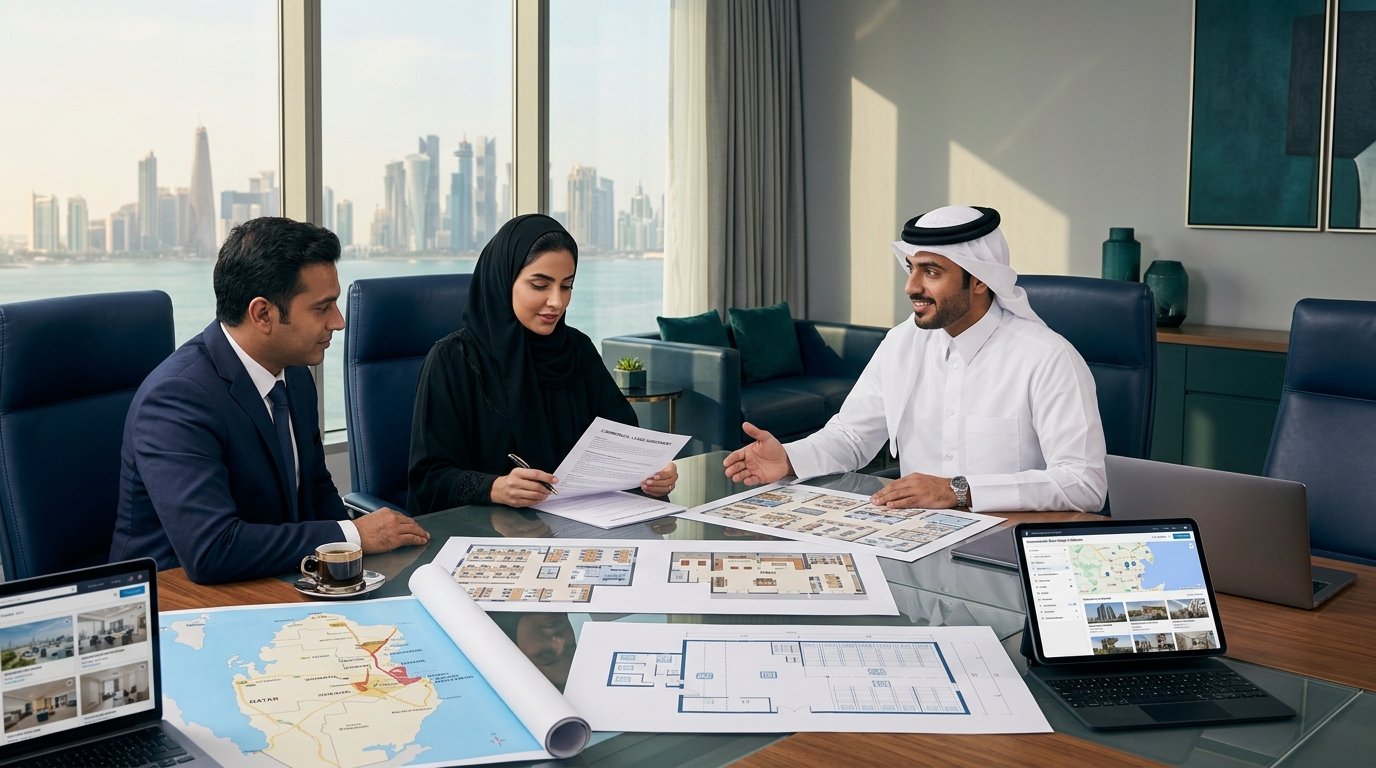
For most businesses in Qatar, the lease is the biggest fixed cost after salaries and the least negotiated. Here is what the market pays, what tenants can ask for and the clauses that decide whether the lease helps or hurts.
Doha has more commercial space than it did five years ago and, in offices in particular, more than tenants currently need. That is good news for anyone signing a lease, if they negotiate. Most tenants do not; they take the landlord's standard form, sign for three years, and discover the escalation clause in year two. A commercial lease in Qatar is negotiable on rent, on incentives and on terms, and the negotiation is worth more per hour than almost anything else an owner does that year.
What the market pays
Indicative headline rents in 2026, per square metre per month, before negotiation:
- Offices: West Bay and Lusail towers QAR 90 to 160 fitted, with Grade A and sea views at the top; older Doha districts (C-Ring, Salwa Road, Al Sadd) QAR 55 to 90; business centres and serviced offices priced per desk.
- Retail: super-regional malls QAR 250 to 500 for in-line units, with prime and F&B higher; community malls and street retail QAR 100 to 220.
- Warehouses and light industrial: Industrial Area and Birkat Al Awamer QAR 25 to 45 for standard sheds, more for temperature-controlled or new logistics parks near the port.
- Showrooms on main roads (Salwa Road, D-Ring) QAR 60 to 120.
Service charges, if separate, add 10 to 20 per cent; ask whether the rent is inclusive of air-conditioning, common areas and parking, because "QAR 100" from one landlord and "QAR 100" from another can be QAR 25 apart once these are added.
What tenants can negotiate
1. Rent-free period: 2 to 6 months on a three-to-five year office lease, more on a large or long commitment; presented as fit-out time and effectively a discount.
2. Fit-out contribution: landlords with empty floors will fund part of the fit-out or deliver a fitted floor; ask for it as a cash contribution or as works to your specification.
3. Escalation: fixed rent for the first term, then a capped increase (3 to 5 per cent at renewal) rather than "market rent" decided by the landlord.
4. Break clause: the right to exit at a defined point (say month 24 of 60) on notice and a penalty; essential for a growing or uncertain business.
5. Expansion and first refusal on adjacent space.
6. Parking: allocated bays in the rent, not charged separately.
7. Cheques: quarterly rather than the full year in advance; deposit at one to two months rather than three.
8. Reinstatement: what you must remove at the end; negotiate to leave the fit-out in place.
What to check before signing - Title and authority: the landlord owns the building or has the right to lease it; the signatory is authorised. The lease must be registered with the Ministry of Municipality's lease registration office to support your commercial registration and visas.
- Permitted use: the building and the unit are approved for your activity (a clinic, a restaurant, a training centre each have their own requirements); the commercial registration will not be issued otherwise.
- Power and cooling: the electrical supply and AC capacity match what a kitchen, a data room or a gym needs; upgrades are expensive and slow.
- Civil Defence status of the building: a building without a valid fire-safety certificate cannot get your unit approved.
- Maintenance obligations: landlord for structure, plant and common areas; tenant for the unit; written response times for landlord repairs.
- Assignment and subletting: the right to assign to a buyer of your business or sublet surplus space, at least with consent not unreasonably withheld.
Where landlords hold the cards
Prime mall units, purpose-built warehouses near the port and fully fitted Grade A floors in short supply. Even there, terms are negotiable: longer commitments, guarantees and a good covenant buy concessions. Everywhere else, the tenant who walks into the negotiation with two alternatives and a written list of asks gets a materially better lease than the tenant who asks "can you reduce a little".
Using an adviser
A licensed commercial agent or tenant-representation adviser knows current asking versus achieved rents, which landlords are flexible and which buildings have problems. Their fee, typically a month's rent or a percentage of the first-year rent, is often paid by the landlord; a tenant-side lawyer reviewing the lease costs QAR 5,000 to 15,000 and is worth it on any lease above QAR 500,000 a year.